Maintenance & reliability
What is predictive maintenance and how do you start? Predictive vs preventive maintenance, sensors, examples
What predictive maintenance is and how to start: predictive vs preventive maintenance, vibration, temperature and current signals, sensors, first steps.
Volkan Alkılıç ·
Our clients
- Siemens

- Anadolu Isuzu

- BSH
- Tofaş

- Toyotetsu

- Martur

- Turkcell

- Vodafone

- Doğadan

- Pakmaya

- Bross

- Abdi İbrahim

- Nobel İlaç

- Plastimak

- Dalgıç Kalıp

- Barbaros Motor

- Magneti Marelli

- Rözmaş

- Sanel


Predictive maintenance means measuring equipment condition, continuously or at regular intervals, through data such as vibration, temperature, current and pressure, and planning maintenance when signs appear that a failure is approaching. The aim is neither to wait until the machine breaks down nor to replace healthy parts just because the calendar says so. It is to do maintenance as close as possible to the moment it is actually needed. It is often abbreviated PdM.
This guide covers how predictive maintenance differs from other maintenance strategies, the measurements and sensors used to watch for early signs of failure, and how to get started with a predictive maintenance solution in a plant.
What is predictive maintenance and what is it for?
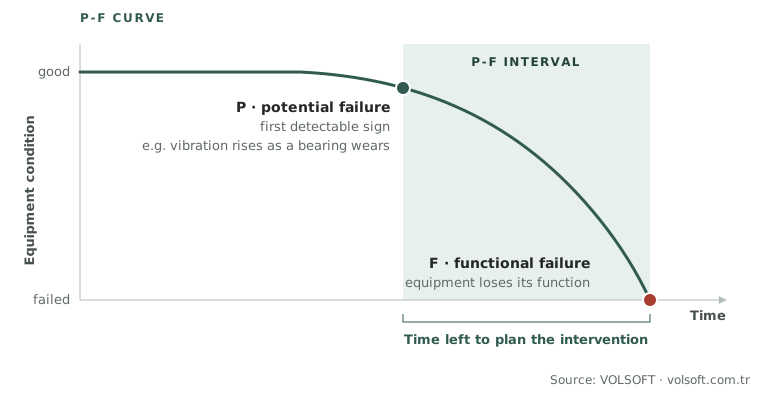
A machine failure rarely happens all at once. When a bearing starts to wear, vibration rises slowly; when a motor starts to strain, the current it draws changes; when an electrical connection loosens, it heats up. Maintenance literature describes this with the P-F curve: there is a stretch of time between the point where the first detectable sign appears (P, potential failure) and the point where the equipment loses its function (F, functional failure).
Use this diagram
You may use this diagram free of charge on your site, in training or in presentations, as long as you credit and link the source. The code below does both.
The real benefit of predictive maintenance is being able to use that time between the first signs of a failure and the machine losing its function. The earlier the signs are detected:
- the more easily maintenance can be fitted into a planned stop, a weekend or a product changeover,
- the earlier spare parts can be ordered,
- the less chance a small fault has to grow and damage other parts,
- the fewer unnecessary periodic replacements are made.
Predictive maintenance is not a device or a piece of software; it is a maintenance strategy. Sensors, data collection and software are the tools of that strategy.
Reactive, preventive, condition-based and predictive maintenance
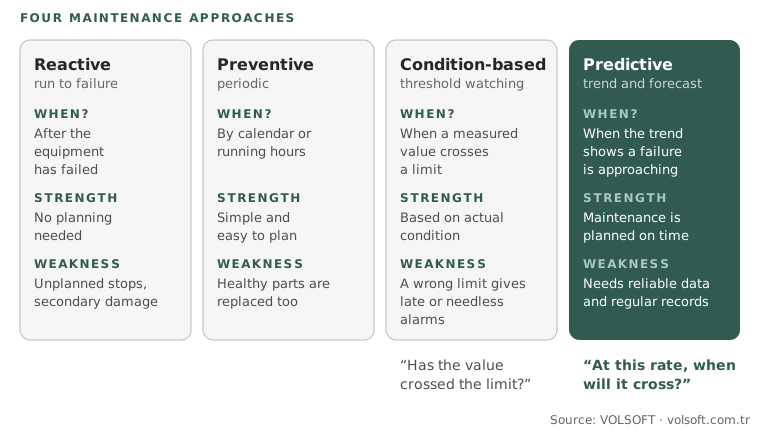
The difference between predictive and preventive maintenance is one of the most commonly confused topics. The four basic maintenance approaches differ like this:
| Approach | When is maintenance done? | Strength | Weakness |
|---|---|---|---|
| Reactive (run to failure) | After the equipment has failed | No planning needed | Unplanned downtime, secondary damage, rush part costs |
| Preventive (periodic) maintenance | By calendar or running hours | Simple and easy to plan | Healthy parts are replaced too; failures between intervals are missed |
| Condition-based maintenance | When a measured value crosses a limit | Based on actual condition | A badly chosen limit gives late or needless alarms |
| Predictive maintenance | When the trend in measured values shows a failure is approaching | Maintenance can be planned at the right time | Needs reliable data, regular records and time |
Use this diagram
You may use this diagram free of charge on your site, in training or in presentations, as long as you credit and link the source. The code below does both.
In practice the line between condition-based and predictive maintenance is not always sharp, and many sources use the two terms interchangeably. The distinction is this: condition-based maintenance asks “has the value crossed the limit now?”, while predictive maintenance asks “at this rate, when will it cross?”. In practice it is usually better to start by monitoring equipment condition and, once enough data has been collected, move on to forecasting failures by analyzing the trends.
These four approaches do not compete with each other. For non-critical, cheap equipment with a spare, reactive maintenance can be a reasonable choice; legally required or safety-related checks are periodic anyway. Predictive maintenance is reserved for equipment whose downtime is expensive.
Which signal warns of which failure?
One of the most important steps in predictive maintenance is choosing the right values to monitor. Every piece of equipment fails in its own way, so each measured value can reveal different signs of failure:
| Signal | How it is measured | Failures it typically warns of |
|---|---|---|
| Vibration | Accelerometer (vibration sensor), portable vibration meter | Bearing wear, imbalance, misalignment, looseness, gear damage |
| Temperature | Temperature sensor, thermal camera | Lubrication problems, overload, friction, loose electrical connections, cooling failure |
| Motor current | Current transformer, drive (inverter) data, power analyzer | Mechanical strain, jamming, rotor problems, loss of pump and fan performance |
| Pressure and flow | Pressure transmitter, flow meter | Leaks, blockages, clogged filters, loss of pump and compressor efficiency |
| Oil analysis | Sample sent to a laboratory | Wear particles, water and dirt ingress, oil degradation |
| Ultrasound | Ultrasonic listening device or sensor | Compressed air and gas leaks, lack of lubrication, electrical partial discharge |
For vibration monitoring on rotating equipment, the most widely used reference is the ISO 20816 series of standards, which defines how machine vibration is measured and evaluated (it replaced the older ISO 10816 series). The series gives a framework for which vibration severity zone counts as acceptable for each machine class. Even so, the most useful comparison when you evaluate measurements is against the same machine’s values from a period when it was running normally.
Sensors and data sources for predictive maintenance
When people hear “predictive maintenance”, they usually think of new sensors and measuring devices. Yet a large share of the data you need can be taken from systems already in the plant:
- PLC and drive data: Motor current, speed, torque, temperature, pressure, running hours and alarm codes are often already read in the PLC or the frequency drive. Recording that data regularly through machine data collection gives you a start without adding a single sensor.
- Power analyzers: Current and power consumption per motor and per line can serve both energy and maintenance. This data is usually read over Modbus; if an energy monitoring system is in place, maintenance can use the same data.
- Additional vibration and temperature sensors: For signals with no counterpart in the PLC, wired or wireless sensors are added. Where cabling is difficult, wireless technologies such as LoRaWAN can be used.
- Maintenance records: Which equipment, when, which failure and what was done. Without these records it is impossible to tell which failures the changes in measured values relate to.
High-frequency vibration data (spectrum, envelope analysis) is very large, and it is often processed next to the machine with only the results sent to the center. That is a typical use of an edge computing architecture.
How to implement predictive maintenance: realistic first steps
A common mistake in predictive maintenance projects is to put sensors all over the plant and expect an AI model to find every failure by itself. A workable start needs only these steps:
- Critical equipment list: Choose the equipment whose stop halts production, that has no spare, or that is slow or expensive to repair. These are usually main motors, pumps, compressors, fans, gearboxes and the bottleneck machines of the line.
- Failure modes: For each critical piece of equipment, talk to the maintenance team about the failures it has had. Choose the signal to monitor according to those failures; “let’s measure everything” produces a pile of data, not information.
- Use the data you already have: Start recording the existing data in the PLC, frequency drives and power analyzers regularly. In many plants this gives useful results without adding any new sensor.
- Sensors for missing signals: Add vibration, temperature or ultrasonic sensors for failure modes that have no counterpart in the existing data.
- Alarm limits and trend tracking: Define the normal operating range for each measured value, then set alarm limits and alerts on trends. Each alarm goes to the right person and says clearly what needs to be done.
- Linking maintenance records: Record what was found at the end of every alarm: was it a real failure or a false alarm? Use these records to improve the limits.
- Modeling: Once enough data and failure history have built up, try forecasting with statistical models or machine learning.
It is worth being honest here: machine learning models work when they have failure examples to learn from. If failures are rare and the data before them was never recorded, there is nothing for the model to predict. In that case you first need to start collecting data regularly, set alarm limits and track trends in the measured values. The model is added on top of that foundation.
For monitoring results to become part of the maintenance team’s daily work, the screens and reports need to be designed too: which equipment’s condition is getting worse, which alarm is open, which work order is waiting. We design this together with dashboards and reporting.
Predictive maintenance examples by industry
- Mining and heavy industry: Conveyor drive motors, crushers and pumps; remote, dusty sites make wireless monitoring and remote access important. Our mining page describes the data needs of these sites.
- Food and beverage: Pumps, mixers, refrigeration compressors and packaging machines; hygiene requirements affect sensor choice and mounting. See food and beverage.
- Metal and steel: Main drive motors, gearboxes, fans and hydraulic systems; high temperatures and vibration make it harder to choose measurement points.
- Energy and utilities: Pump stations, transformers and compressors; because the equipment is spread out, central monitoring is valuable.
What these examples have in common is that unplanned stops are expensive and equipment degrades over time. That is where predictive maintenance pays off most.
Predictive maintenance, OEE and downtime tracking
Predictive maintenance aims to reduce unplanned downtime, and its effect shows up in the availability factor of OEE. To know which equipment stops, for how long and why, you also need downtime tracking. Downtime records are the most solid basis for deciding which equipment predictive maintenance should start with: the equipment that stops most often and longest goes to the top of the list.
From the field: what we often see in predictive maintenance projects
- Monitor first, forecast later. Rather than starting predictive maintenance with AI, we recommend first collecting machine data regularly and making downtime and alarms visible. At Doğadan, an OEE monitoring and alarm system was installed first for the tea packaging machines; predictive maintenance was planned as the next phase on top of that data.
- Existing data is often a good enough start. Alarm history in the PLC, cycle times, motor current from the drive and power analyzer readings show the first trends without adding sensors. We add new sensors for the failure types that this data cannot answer.
- Without failure records, no model can learn. If nobody records which failure happened when and what was done, nobody can learn what a change in the measurements is warning of. That is why one of the first jobs in our projects is to make failure and intervention records consistent.
- Few alarms, clearly explained. Many vague alarms lead the maintenance team to ignore them. Who each alarm goes to and what needs to be done should be defined from the start.
Conclusion
Predictive maintenance monitors equipment condition through regular measurements so that maintenance is done when it is actually needed. Its success does not come from the number of sensors or from an AI model; it comes from choosing the right equipment, measuring the signal that fits how that equipment fails, and recording the outcome of every alarm. The healthiest start is a critical equipment list, recording of existing PLC and drive data, and well-set limits. Forecasting models are added on top of that foundation.
Related guides: MTBF and MTTR: how to calculate them, What is a production tracking system?
At VOLSOFT we build data collection, signal processing, alarms and screens for predictive maintenance projects on Proxus. If you would like to talk about where it makes sense to start in your plant, talk to one of our engineers.